ASPIC

envie a um amigo share this

Magnetic liposomes as nanocarriers for a new potential antitumor drug

A research team leaded by Elisabete Castanheira and Paulo Coutinho, of the Centre of Physics of University of Minho, has been focused on the development of magnetic liposomes (“magnetoliposomes”), which combine magnetic nanoparticles and liposomes. The developed systems have been tested as nanocarriers for new potential antitumor drugs. The latter have been obtained at the Centre of Chemistry of University of Minho (Maria João Queiroz’s research group). In this study, recently published, a new molecule especially active against breast cancer was tested.

Lipossomas magnéticos para transporte de um novo potencial fármaco antitumoral

Uma equipa de investigadores liderada por Elisabete Castanheira e Paulo Coutinho, do Centro de Física da Universidade do Minho, tem-se dedicado ao desenvolvimento de lipossomas magnéticos (“magnetolipossomas”), que combinam nanopartículas magnéticas e lipossomas. Os sistemas desenvolvidos vêm sendo testados como transportadores de novos potenciais fármacos antitumorais. Estes últimos são obtidos no Centro de Química da Universidade do Minho (grupo da investigadora Maria João Queiroz).

Portuguese group combine nanoparticle delivery of gene therapy and standard chemotherapy to overcome leukemia

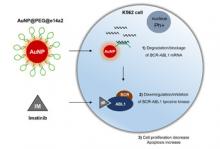
Specific gene silencing was vectorized via gold nanoparticles to enhance the killing potential of chemotherapy against leukemia cells. By targeting the fusion oncogene BCR-ABL1 using gold nanoaprticles in chronic myeloid leukemia cells, the Portuguese researchers were capable to enhance the therapeutic efficacy of standard chemotherapy in a combined strategy that this groups has been optimizing at UCIBIO (Research Unit on Applied Molecular Biosciences), Faculdade de Ciências e Tecnologia of Universidade Nova de Lisboa.

Investigadores portugueses combinam silenciamento génico por nanopartículas de ouro e quimioterapia standard no combate à leucemia

Recorrendo ao silenciamento génico específico em células de leucemia mediado por nanopartículas de ouro, um grupo de investigadores portugueses conseguiu aumentar a eficácia terapêutica da quimioterapia standard. De facto, em células de leucemia mieloide crónica, a entrega de um silenciador do oncogene BCR-ABL1 viu a sua potencia maximizada pela vectorização em nanopartículas de ouro coloidal, uma estratégia que tem vindo a ser optimizada por este grupo na Faculdade de Ciências e Tecnologia da Universidade Nova de Lisboa.

Cellular Stress Increases the Probability of Developing Autoimmune Diseases

A team of researchers led by Marc Veldhoen, Instituto de Medicina Molecular (iMM), Lisboa, have found that cellular stress enhances the activation of certain type of immune cells implicated in many chronic inflammatory conditions, increasing the risk of autoimmune diseases. 


Authors and Affiliations:

Stress celular aumenta a probabilidade de desenvolver doenças autoimunes

Uma equipa de investigadores liderada por Marc Veldhoen, do Instituto de Medicina Molecular (iMM), Lisboa, descobriu que o stress celular aumenta a ativação de um tipo especifico de células imunes ligadas a várias doenças inflamatórias crónicas, aumentando assim o risco de desenvolver autoimunidade.


Autores e Afiliações:

Aberrant Glycosylation in Cancer: A Novel Molecular Mechanism Controlling Metastasis – PREVIEW

Major alterations in cell glycosylation occurring during cancer development and progression represent key features of tumor cell malignant behavior. In this publication, the authors preview and put in context the findings of Agrawal et al. (Cancer Cell, Vol. 31, Issue 6, 2017) that identified and characterized a novel molecular mechanism in which aberrant glycosylation actively tunes the metastatic capacity of melanoma cells by preventing the proteolytic cleavage of the L1CAM adhesion molecule.


Authors and Affiliations:

Aberrant Glycosylation in Cancer: A Novel Molecular Mechanism Controlling Metastasis – PREVIEW

Major alterations in cell glycosylation occurring during cancer development and progression represent key features of tumor cell malignant behavior. In this publication, the authors preview and put in context the findings of Agrawal et al. (Cancer Cell, Vol. 31, Issue 6, 2017) that identified and characterized a novel molecular mechanism in which aberrant glycosylation actively tunes the metastatic capacity of melanoma cells by preventing the proteolytic cleavage of the L1CAM adhesion molecule.


Autores e Afiliações:

Identification of somatic TERT promoter mutations in familial nonmedullary thyroid carcinomas

Familial nonmedullary thyroid carcinoma (FNMTC) accounts for nearly 5% of all thyroid carcinomas of follicular cell origin. The genes causing FNMTC identified to date are only involved in a small fraction of the families and, thus, the molecular basis of this disease remains mainly unknown.

The aim of this study was to investigate the role of TERT promoter and EIF1AX germline and somatic mutations in families with FNMTC.

Identificação de mutações somáticas no promotor do TERT em carcinomas não medulares da tiróide familiares

As formas familiares de carcinomas não-medulares da tiróide (FNMTC) representam cerca de 5% das neoplasias malignas da tiróide de origem folicular.  Embora tenham sido propostos novos genes de susceptibilidade para o FNMTC, estes apenas se encontram envolvidos numa pequena fracção das famílias, permanecendo a base molecular desta doença essencialmente desconhecida.

Este trabalho teve como objectivo pesquisar mutações germinais e somáticas nos genes TERT (promotor) e EIF1AX em famílias com FNMTC.