
Associação Portuguesa de Investigação em Cancro
EGFR and STAT3 as therapeutic targets in ETV1-positive prostate cancer
EGFR and STAT3 as therapeutic targets in ETV1-positive prostate cancer
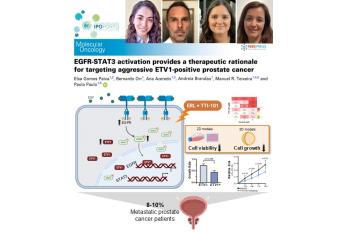
Researchers from the Cancer Genetics Group at IPO Porto, in collaboration with the School of Medicine and Biomedical Sciences at the University of Porto (ICBAS), have uncovered a key singaling pathway driving the aggressiveness of prostate tumors that overexpress ETV1. The team found that simultaneous activation of the EGFR and STAT3 signaling pathways fuels the malignant behavior of these cancers. By jointly blocking these pathways with Erlotinib (an EGFR inhibitor) and TTI-101 (a STAT3 inhibitor), the researchers achieved a striking synergistic reduction in tumor growth across both 2D and 3D prostate cancer models with ETV1 overexpression. These results highlight a promising therapeutic strategy for the 8–10% of prostate carcinomas marked by ETV1overexpression—an aggressive subgroup for which effective precision-based treatments are still urgently needed.
Authors and Affiliations:
Elsa Gomes Paiva1,2, Bernardo Orr1, Ana Azeredo1,3, Andreia Brandão1, Manuel R Teixeira1,4,5, Paula Paulo1,5*
1 Cancer Genetics Group, IPO Porto Research Center (CI‐IPOP)/RISE@CI‐IPOP (Health Research Network), Portuguese Oncology Institute of Porto (IPO Porto)/Porto Comprehensive Cancer Center, Portugal
2 PhD Program in Biomedical Sciences, School of Medicine and Biomedical Sciences (ICBAS), University of Porto, Portugal
3 Master Program in Oncology, School of Medicine and Biomedical Sciences (ICBAS), University of Porto, Portugal
4 Department of Laboratory Genetics, Portuguese Oncology Institute of Porto (IPO Porto)/Porto Comprehensive Cancer Center Raquel Seruca (Porto.CCC Raquel Seruca), Portugal
5 School of Medicine and Biomedical Sciences (ICBAS), University of Porto, Portugal
*Correspondence to P. Paulo, Portuguese Oncology Institute of Porto (IPO Porto), 4200‐072 Porto, Portugal, Tel: +351225084000, ext. 5609, E‐mail: [email protected]
Abstract:
Prostate cancer (PCa) is the fifth leading cause of cancer‐related death. The lack of data linking genomic alterations to targeted treatment strategies has hindered progress in disease management. Genomic rearrangements involving the ETS transcription factors ERG or ETV1 are among the most frequent genetic alterations in PCa; however, their clinical utility remains elusive. Using PCa cells overexpressing ETV1 or ERG, representing early and advanced disease stages, we unveiled a positive feedback loop between ETV1 and EGFR, with STAT3 acting as a downstream effector of ETV1–EGFR signaling. Analysis of external datasets revealed that both EGFR and STAT3 are significantly upregulated in ETV1‐positive PCa, consistent with ChIP‐seq data identifying them as direct ETV1 targets. Accordingly, combined inhibition of EGFR and STAT3 using Erlotinib and TTI‐101, respectively, led to a significant reduction in 2D and 3D cell growth of early and advanced PCa cells overexpressing ETV1. Collectively, our findings highlight EGFR–STAT3 activation as a novel ETV1‐regulated oncogenic pathway, providing a rationale for repurposing EGFR inhibitors in combination with STAT3 inhibitors as a therapeutic strategy for the 8–10% of prostate carcinomas characterized by ETV1 rearrangements/overexpression.
Journal: Molecular Oncology
Link: https://pmc.ncbi.nlm.nih.gov/articles/PMC12591323/#mol270069-sec-0025


