
Associação Portuguesa de Investigação em Cancro
Hydroxytyrosol targets stemness and enhances chemotherapeutic response in 3D metastatic colorectal cancer spheroids
Hydroxytyrosol targets stemness and enhances chemotherapeutic response in 3D metastatic colorectal cancer spheroids
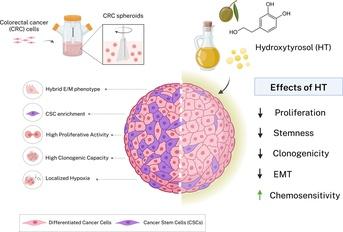
This study provides the first evidence that hydroxytyrosol, a molecule isolated from virgin olive oil, targets Colorectal Cancer (CRC) CSC (Cancer Stem Cells) -associated phenotypes and synergistically enhances irinotecan efficacy in metastatic CRC spheroids. These findings position hydroxytyrosol as a promising adjuvant strategy to counteract CSC-associated drug resistance and sensitize metastatic CRC cells to chemotherapy, supporting its further evaluation as a chemosensitising agent in advanced CRC.
Authors and Affiliations:
b Instituto de Tecnologia Química e Biológica António Xavier, Universidade Nova de Lisboa (ITQB NOVA), Av. da República, 2780-157, Oeiras, Portugal
c Unidade de Investigação em Patobiologia Molecular (UIPM), Instituto Português de Oncologia de Lisboa Francisco Gentil, E.P.E (IPOLFG, EPE), 1099-023, Lisboa, Portugal
d Faculdade de Farmácia da Universidade de Lisboa, Av. das Forças Armadas, 1649-019, Lisboa, Portugal
Abstract:
Background: Cancer stem cells (CSCs) are increasingly recognized as critical mediators of tumour progression, recurrence and treatment resistance in metastatic colorectal cancer (CRC). Hydroxytyrosol, a phenolic compound derived from virgin olive oil, has shown promising anticancer activity against CRC cells. However, its effects on cancer stemness and its potential to enhance the efficacy of conventional chemotherapy drugs remain largely unexplored.
Purpose: To assess whether hydroxytyrosol suppresses CSC-associated traits and improves chemotherapy response using a 3D spheroid model established from the metastatic CRC cell line LoVo.
Methods: LoVo spheroids were generated under stirred-tank culture conditions and characterized by molecular and functional assays. Hydroxytyrosol effects on LoVo spheroids were assessed using cell viability, ALDH activity, clonogenic and RT-qPCR assays. Drug combination interactions were determined using the Chou-Talalay method.
Results: LoVo spheroids recapitulated key tumour features, including a hybrid epithelial-mesenchymal phenotype, enhanced stemness, high clonogenic capacity, and localized hypoxia. Hydroxytyrosol reduced cell proliferation in a dose-dependent manner, with LoVo spheroids exhibiting greater resistance than 2D cultures (IC50: 1454 µM vs 91 µM). Hydroxytyrosol significantly decreased ALDH activity at 125–500 µM (39–57%) and clonogenic potential at 1–100 µM (21–84%). It also significantly affected the expression of markers associated with the proliferation (CDKN1A), epithelial-mesenchymal transition (VIM), Wnt/β-catenin (AXIN2) and stemness (CD44, CD133 and LGR5). In combination studies, hydroxytyrosol showed strong synergistic interactions with the chemotherapy drug irinotecan (Combination Index: 0.07–0.15). Similar effects were observed in CSC-enriched HT29 spheroids.
Conclusion: This study provides the first evidence that hydroxytyrosol targets CRC CSC-associated phenotypes and synergistically enhances irinotecan efficacy in metastatic CRC spheroids. These findings position hydroxytyrosol as a promising adjuvant strategy to counteract CSC-associated drug resistance and sensitize metastatic CRC cells to chemotherapy, supporting its further evaluation as a chemosensitising agent in advanced CRC.
Journal: Phytomedicine
Link: https://www.sciencedirect.com/science/article/pii/S0944711326011050?via%3Dihub


