ASPIC

envie a um amigo share this

EORTC / Endocrine Task Force 2017 & Grupo de estudo da tireoide da SPEDM

i3S - Ipatimup, Porto, Portugal


28 November, 2017

See more informations here: https://www.ipatimup.pt/Site/ActivityView.aspx?ActivityId=3042
 

EORTC / Endocrine Task Force 2017 & Grupo de estudo da tireoide da SPEDM

i3S - Ipatimup, Porto, Portugal


28 November, 2017

See more informations here: https://www.ipatimup.pt/Site/ActivityView.aspx?ActivityId=3042
 

Institucional and semantic dimensions of oncology research in Portugal

Authors and Affiliations:

Oriana Rainho Brás1,2, Jean-Philippe Cointet3, Alberto Cambrosio4, Leonor David2,5,6,7, João Arriscado Nunes8,9, Fátima Cardoso2,10, Carmen Jerónimo2,11,12

Institucional and semantic dimensions of oncology research in Portugal

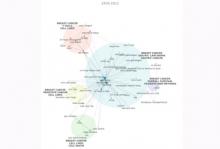
A ASPIC publica este mês os primeiros resultados do projecto ReportCancer/CancerReport: Researching the dynamics and international positioning of the portuguese medical oncology community. Tendo por base a análise cientométrica das publicações portuguesas nas bases de dados Medline/PubMed e Web of knowledge, este estudo veio preencher uma enorme lacuna de conhecimento sobre a investigação em cancro em Portugal na segunda metade do século XX e início do século XXI.

Thyroid Nodule - can molecular tests improve fine-needle aspiration cytology diagnostic assessment?

Fine-needle aspiration (FNA) has high sensitivity and specificity in distinguishing benign from malignant thyroid lesions. However, in 5-20% of the cases belonging to the indeterminate cytology categories (follicular neoplasms and atypia of undetermined significance) it is not possible to discriminate between benign and malignant tumours. As a consequence of this limitation, patients with such diagnoses have to be submitted to diagnostic rather than to curative thyroid surgery.

Thyroid Nodule - can molecular tests improve fine-needle aspiration cytology diagnostic assessment?

Fine-needle aspiration (FNA) has high sensitivity and specificity in distinguishing benign from malignant thyroid lesions. However, in 5-20% of the cases belonging to the indeterminate cytology categories (follicular neoplasms and atypia of undetermined significance) it is not possible to discriminate between benign and malignant tumours. As a consequence of this limitation, patients with such diagnoses have to be submitted to diagnostic rather than to curative thyroid surgery.

Calcitonin receptor expression in medullary thyroid carcinoma

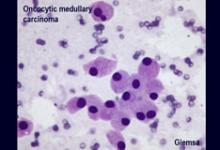
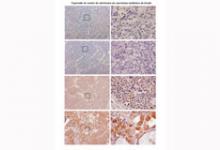
Medullary thyroid carcinoma (MTC) is a rare tumor representing 5–10% of thyroid cancers, with a 10-year survival rate is about 50–75%. It arises from a particular thyroid cell type: the parafollicular C-cells of the thyroid which secrete calcitonin (CT). Serum CT is a very sensitive and specific method for diagnosing MTC, however, the potential role of calcitonin receptor (CTR) expression on tumor aggressiveness and prognosis remained to be explored.

Expressão do recetor da calcitonina nos carcinomas medulares da tiroide

O carcinoma medular da tiroide (CMT) é um tumor raro, representando cerca de 5-10% de todos os carcinomas da tiroide, com uma taxa de sobrevida livre de doença aos 10 anos de 50-75%. Este carcinoma provém de um tipo particular de células tiroideias, denominadas células C, produtoras de calcitonina (CT). Os níveis séricos de CT são um marcador de diagnóstico muito sensível e especifico dos CMT, no entanto, o potencial papel do recetor da calcitonina (RCT) relativamente à agressividade tumoral e prognóstico, permanece desconhecido.

Infection with Opisthorchis felineus induces intraepithelial neoplasia of the biliary tract in a rodent model

Authors and Affiliations:

Gouveia MJ1,2, Pakharukova MY3,4, Laha T5,6,7, Sripa B5,6,7, Maksimova GA3, Rinaldi G8, Brindley PJ8, Mordvinov VA3,9, Amaro T10, Santos LL10, Costa JMCD1,11, Vale N2,12.


1 Center for the Study in Animal Science, ICETA, University of Porto, Rua de D. Manuel II, Apt 55142, 4051-401 Porto, Portugal.

Infection with Opisthorchis felineus induces intraepithelial neoplasia of the biliary tract in a rodent model

Autores e Afiliações:

Gouveia MJ1,2, Pakharukova MY3,4, Laha T5,6,7, Sripa B5,6,7, Maksimova GA3, Rinaldi G8, Brindley PJ8, Mordvinov VA3,9, Amaro T10, Santos LL10, Costa JMCD1,11, Vale N2,12.


1 Center for the Study in Animal Science, ICETA, University of Porto, Rua de D. Manuel II, Apt 55142, 4051-401 Porto, Portugal.